

How depth cues transform visual art: Techniques artists use to create space and meaning
Depth cues are the visual signals that tell a viewer where objects sit in space and how far they are from each other. For artists depth cues are essential tools for crafting believable scenes and guiding emotional response. Whether working on canvas photography sculpture or installation art understanding depth cues allows creators to build illusions of space and to control how a viewer moves through an image.
What are depth cues and why they matter in art
Depth cues are features in a visual scene that indicate distance or spatial relations. The human visual system uses many different cues to interpret a flat retinal image as a three dimensional world. Artists borrow these natural cues to suggest volume and depth within a flat surface and to emphasize focal points. When used intentionally depth cues can add realism create drama and enhance narrative clarity.
Major categories of depth cues used by artists
Depth cues are often grouped into two main categories. One group depends on input from both eyes and the other group works with a single eye. Both groups are useful for artists depending on medium and intent.
Binocular depth cues
Binocular cues require both eyes. In real life these cues help with fine depth estimation at close range. Artists who make work meant to be experienced in three dimensional space like sculpture or installation can exploit binocular cues through placement scale and viewer interaction.
- Stereopsis This is the slight difference between images from each eye that creates a sense of depth. Stereoscopic photography and stereoscopic display techniques reproduce this effect.
- Convergence The angle at which the eyes turn inward to focus on a nearby object. In immersive art experiences artists place objects within reaching distance to elicit this cue.
Monocular depth cues
Monocular cues work with one eye and are the core tools for painters photographers and illustrators. They are highly adaptable and provide powerful ways to suggest distance on a two dimensional surface.
- Linear perspective Parallel lines appear to meet at a point on the horizon. Single point perspective two point perspective and multi point perspective offer different ways to organize space and direct the eye.
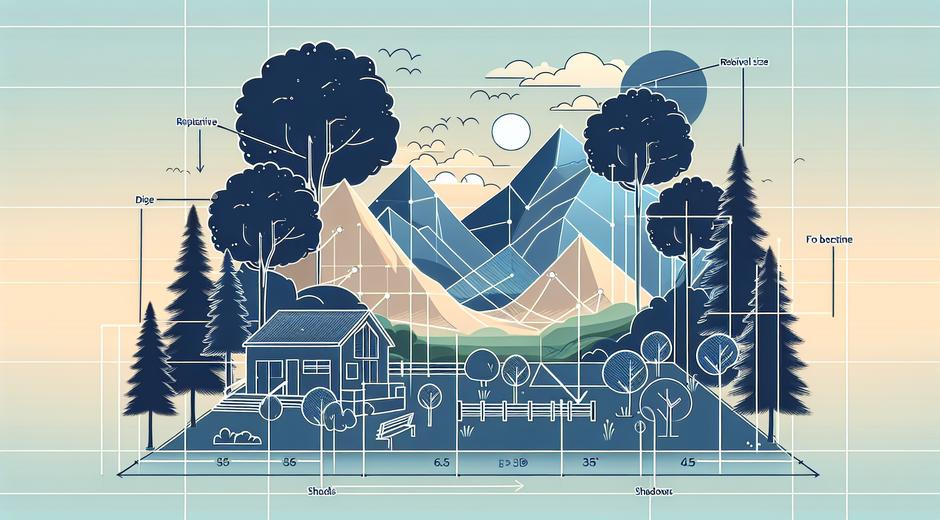
- Relative size When two objects are known to be similar the smaller one will appear farther away. Artists vary scale to imply distance and to create foreground middle ground and background layers.
- Occlusion When one object overlaps another the overlapping object appears closer. This simple cue is central to clear figure ground relationships.
- Texture gradient As a textured surface recedes details become finer and denser. Painters use less detailed brushwork for distant elements.
- Aerial perspective Also called atmospheric perspective this cue uses reduced contrast reduced saturation and a shift toward cooler tones to simulate air between viewer and object.
- Light and shadow Cast shadows attached shadows and shading reveal form and position. Strong directional light enhances perceived depth.
- Motion parallax When a viewer moves nearby objects shift position faster than distant objects. Artists can imply motion parallax in sequential work or when designing installations that respond to viewer movement.
Practical techniques for artists to apply depth cues
Integrating depth cues into your practice need not be technical. Here are practical strategies that work across media.
- Layer composition Establish a clear foreground middle ground and background. Place the most detailed elements in the foreground and reduce detail as you move back.
- Control value and contrast High contrast draws attention. Use stronger contrast and richer color for closer planes and lower contrast for distant planes.
- Use overlapping shapes Overlap creates immediate depth. Even subtle overlaps can prevent a composition from appearing flat.
- Apply color temperature shifts Warm colors appear closer than cool colors. A warm cast in the foreground and cool hues in the background increase perceived space.
- Employ perspective lines Use perspective to guide a viewer toward a focal point. Roads fences and architecture are natural networks for linear perspective.
- Refine edges Hard edges tend to come forward soft edges recede. Adjust edge clarity to control depth emphasis.
- Simulate atmosphere Add haze or softening for distant elements. This is especially effective in landscape work.
Examples from art history and contemporary practice
Artists have used depth cues across eras. Renaissance painters refined linear perspective to create immersive illusionistic spaces. Later landscape painters like those from the romantic tradition exploited aerial perspective to evoke mood. Contemporary photographers often use shallow depth of field to separate subject and background. Installation artists design walkable spaces that activate binocular cues and motion parallax as viewers move through an environment.
Understanding these historical and contemporary strategies helps makers choose the right cues for their concept. For process breakdowns step by step tutorials and curated references visit museatime.com where you can explore guides that clarify how depth cues function across materials.
Exercises to train your eye and hands
Regular practice will make depth cues intuitive. Try these exercises to build visual fluency.
- Thumbnail sketches Draw many quick compositions focusing on different dominant cues. Make one that relies on occlusion another on perspective and another on aerial perspective.
- Value studies Paint three value layers foreground middle ground background. Evaluate how contrast affects perceived space.
- Color experiments Create a simple landscape and vary only the color temperature to see the effect on depth.
- Photographic observation Take photos of a scene at different focal lengths and apertures to observe how depth cues change.
- Installation mockups If you work in three dimensions arrange objects at different distances and move to note binocular and motion cues.
Common mistakes and how to avoid them
Even experienced makers can unintentionally flatten space. Here are pitfalls and remedies.
- Over reliance on one cue Relying only on size for depth can feel artificial. Combine multiple cues for stronger results.
- Ignoring lighting Flat lighting removes cast shadows and can collapse depth. Consider directional light to reveal form.
- Conflicting cues If perspective lines suggest one depth relationship but shadows suggest another viewers feel unease. Check for consistency across cues.
- Excessive detail everywhere Too much detail in every plane creates visual competition. Reserve detail for areas that support your concept.
How depth cues influence viewer engagement and meaning
Depth cues do more than make an image look three dimensional. They shape narrative focus determine emotional tone and guide eye movement. A compressed shallow space can create tension or intimacy. A vast layered space can inspire awe or solitude. By manipulating depth cues artists control pacing and emphasis in a composition.
For example a portrait with strong foreground detail shallow depth of field and softened background can feel immediate and personal. A cityscape using converging lines and atmospheric recession can feel dynamic and expansive. Being mindful about these choices allows you to align visual space with concept.
Resources and further reading
To deepen your study of how perception and technique intersect consider cross disciplinary resources that bridge art and science. For curated reading recommendations and tools that explore taste and visual decision making visit TasteFlavorBook.com. Combining practice with research will accelerate your ability to use depth cues effectively.
Conclusion
Depth cues are foundational language for visual art. They let artists sculpt space draw attention and evoke feeling. By learning to read and apply binocular and monocular cues you gain precise control over how a viewer experiences your work. Regular exercises observing reality and testing compositional variations will make these tools second nature. Start small apply one new cue at a time and observe the change. Over time the careful use of depth cues will transform how your work communicates space and meaning.