

Geometry in Art: How Geometry Shapes Visual Creativity
Why geometry matters in art
Geometry is a silent architect inside every work of art. From the symmetry of a classical sculpture to the precise grid behind a modern painting geometry helps artists create balance rhythm and meaning. When painters and designers talk about proportion and composition they are describing principles that come directly from geometry. By understanding geometry artists can control sightlines guide the gaze and evoke emotion through form.
Historical use of geometry in artistic traditions
Across cultures geometry has been a tool for both practical design and spiritual expression. Ancient builders used geometry to align temples and monuments with celestial events. In classical painting geometry informed the canon of proportions that guided figure drawing. In Islamic art geometry became a primary means of ornamentation producing complex tessellations that invite meditative focus. Renaissance masters studied geometry as a way to create convincing space and light. Their exploration of perspective and orthogonals allowed scenes to feel three dimensional while being painted on a flat surface.
Geometry and composition techniques
Composition is where geometry meets storytelling. Artists use geometric constructs such as the golden ratio the rule of thirds and radial symmetry to compose imagery that feels natural or intentionally unsettling depending on the goal. Grids provide a framework for placing focal points while diagonals create dynamic energy. Circles can emphasize unity and completeness. Triangles often create stability or point toward a direction. Knowing these geometric options gives an artist a vocabulary for shaping viewer response.
Famous artists who embraced geometry
Some of the most influential artists of the past centuries made geometry a central element of their visual language. Piet Mondrian reduced landscapes to vertical and horizontal planes to explore universal harmony. Wassily Kandinsky used geometric motifs to express music like qualities in painting. M C Escher combined mathematical precision with imaginative perspective to produce impossible constructions. Even architects such as Le Corbusier used geometry to articulate modern living spaces and to define a sense of order.
Geometry in sculpture and architecture
Sculptors and architects use geometry to resolve mass and void light and shadow. A sculpture is a dialogue of volumes where geometric forms intersect and interact. Architects translate spatial concepts into habitable geometry creating rhythm through columns planes and voids. Proportional systems rooted in geometry create comfort and continuity. In public art the clarity of geometric forms helps pieces hold up against changing light and atmospheric conditions making them readable at a distance.
Geometry in digital and new media art
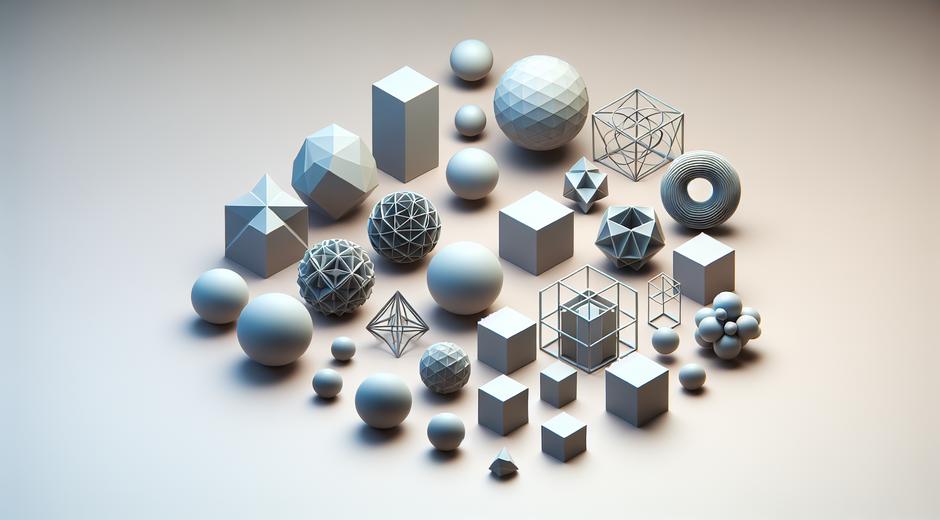
In the digital age geometry is both concept and tool. Vector graphics rely on points lines and curves that are explicitly geometric. Procedural generation uses mathematical rules to create complex patterns and landscapes from simple geometric primitives. Generative artists use algorithms to manipulate geometry over time producing work that evolves and reacts to data. For digital sculptors and 3D modelers geometry is literally the language of form as meshes are constructed from vertices edges and faces.
Color pattern and geometry
Geometry and color work together to reinforce composition. Repeating geometric patterns can be made vibrant with contrasting color choices or soft with a muted palette. Artists who design patterns and textiles leverage geometry to create rhythms that are pleasing to the eye and easy to reproduce. When pattern becomes too rigid color can soften the perception of geometry adding warmth and movement without sacrificing structural clarity.
Teaching geometry to artists
Learning geometry does not mean sacrificing intuition. Many art schools teach geometry through hands on exercises that reveal how form behaves. Simple practice such as drawing ellipses constructing perspective grids or dissecting masterworks helps artists internalize geometric relationships. Exercises that break subjects into geometric shapes strengthen observational skills and speed. Once basic geometry becomes intuitive an artist can decide when to follow rules and when to bend them for personal expression.
Practical exercises to explore geometry
Try these studio experiments to sharpen your geometric sensibility. Start with blind contour drawings and then reduce the forms into geometric primitives. Create a series of small studies focused on arranging circles squares and triangles within a fixed format. Experiment with tiling a surface using geometric patterns and then alter one rule to see how a single change affects the entire composition. Use perspective grids to stage a simple interior scene and then vary the vanishing points to create tension or calm. These exercises are useful for painters sculptors and digital artists alike.
Tools that make geometry accessible
Contemporary artists have access to a wide range of tools that make geometric experiments easier to control and refine. Digital software allows precise manipulation of geometry while keeping the option to introduce organic variation. Traditional tools such as compass rulers and set squares still provide a tactile way to construct perfect arcs and angles. For inspiration and case studies artists can consult curated collections and online galleries that highlight geometric work. For example you can explore curated articles and galleries on our site at museatime.com to see how artists apply geometry across media.
Applying geometry in your creative practice
If you want geometry to become a deliberate part of your work start by analyzing compositions that move you. Look for the underlying lines and forms then recreate them as a drawing exercise. Once you recognize patterns in other works you can begin to incorporate those structures in your own pieces. Use geometry to test composition choices quickly before committing to a final work. Try creating multiple thumbnails that explore different geometric constructs such as concentric arrangements or offset grids. This iterative practice increases the likelihood that the final piece will feel both intentional and surprising.
Collaborations and learning opportunities
Collaborating with artists who specialize in fields such as architecture or graphic design can deepen your practical understanding of geometry. Workshops and online courses often provide focused time to study specific geometric techniques. For tools and services that support creative collaboration look into platforms that bridge artists with designers to develop projects that harness geometric principles. A resource that many professionals use to source partners and inspiration is available at Zoopora.com where curated listings connect creative teams and galleries.
Conclusion
Geometry is not a set of rigid rules but a flexible language for shaping visual experience. Whether you are a painter sculptor designer or digital creator geometry can help you articulate ideas with clarity and impact. Studying geometric systems enhances observational skills improves composition and opens up new methods of making. Begin with small experiments embrace both tradition and innovation and let geometry become a playful guiding force in your art practice.